Séminaire inter-laboratoires CECILLE-STL "TRAIL : TRAnslation In Lille"
Traduction & médiation SéminaireSéminaire TRAIL | TRAnslation In Lille
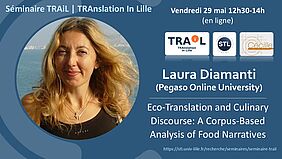
La prochaine séance du séminaire TRAIL (TRanslation In Lille), séminaire inter-laboratoire STL-CECILLE sur les questions de traduction et de traductologie, aura lieu en distanciel le vendredi 29 mai 2026 de 12h30 à 14h.
Interviendra Laura Diamanti (Pegaso Online University) : "Eco-Translation and Culinary Discourse: A Corpus-Based Analysis of Food Narratives"
Abstract
Eco-Translation and Culinary Discourse: A Corpus-Based Analysis of Food Narratives
Culinary discourse examined from the perspective of translation ecology entails translation encompassing interrelated linguistic, cultural, and environmental systems, by emphasising the translator’s ethical responsibility in sustaining diversity and knowledge transmission (Hu, 2020: 70-74; Cronin, 2017: 11-19; Tymoczko, 2014: 3-9). Recipes reproduce collective memory, social identity, and everyday knowledge, whose meanings are to be mediated across languages (Cronin, 2017: 35-52; Hu, 2020: 6-8; Diamanti, 2025: 1-2). Food narratives are therefore analysed as sites where language, tradition, and lived experience intersect, emphasising the role of translation in preserving communicative integrity (Diamanti, 2025: 10-12).
The study draws on a corpus of Nigella Lawson’s cookbooks and adopts mixed methods combining register segmentation, corpus-driven stratification, and lexical diversity measurement using the MTLD index (Biber, 1988: 170-175; McCarthy and Jarvis, 2010: 381-382). This approach enables the systematic identification of semantic and pragmatic patterns across ingredients, instructions, and narrative commentary, showing that narrative passages display higher lexical diversity and denser affective and symbolic content. The findings support the interpretation of culinary prose as a layered semiotic ecosystem in which linguistic variation reflects the distribution of meaning across registers (Diamanti, 2025: 1-2, 10-12). The translational implications of this ecological perspective suggest how elements such as domestic rituals, national food memories, and sensory imagery serve as markers of identity continuity in culinary texts (Diamanti, 2025: 10-12).
References
Biber, D. (1988). Variation across speech and writing. Cambridge University Press.
Cronin, M. (2017). Eco-Translation: Translation and Ecology in the Age of the Anthropocene. London and New York: Routledge.
Diamanti, L. (2025). Ecologic Translation and Culinary Identity: Semiosis of the Language of Food in Lawson’s English Recipes. In L. Diamanti, E. Gallitelli, E. N. Ravizza (eds) Towards an Ecology of Translation: Translating Nature, Places and Identities in the Global World. mediAzioni 49: A60-A86, https://doi.org/10.60923/issn.1974-4382/24169, ISSN 1974-4382.
Hu, G. (2020). Eco-Translatology. Towards an Eco-Paradigm of Translation Studies. Springer Nature Singapore.
McCarthy, P. M., & Jarvis, S. (2010). MTLD, vocd-D, and HD-D: A validation study of sophisticated approaches to lexical diversity assessment. Behavior Research Methods, 42(2), 381-392.
Tymoczko, M. (2014). Translation, resistance, activism: An overview. In M. Tymoczko, (ed), Translation, resistance, activism. Amherst and Boston: University of Massachusetts Press.
Biosketch
Laura Diamanti is Associate Professor of English Language, Translation and Linguistics at Pegaso University (Rome). Her research lies at the intersection of translation studies, corpus linguistics, and discourse analysis, with a particular focus on eco-translation and the linguistic representation of cultural and media texts. She has developed research on hybrid communicative genres such as film reviews and culinary discourse, examining evaluative language, metaphor, and pragmatic meaning in translation and reception. Her recent work explores how translation strategies shape the transmission of cultural identity, sensory experience, and meaning across languages, particularly in culinary narratives. She is a member of the CLAVIER Research Group (Roma Tre University), the international Eco-Translation Network (University of Edinburgh), and the TECNAL Research Laboratory (University of Cassino and Southern Lazio).