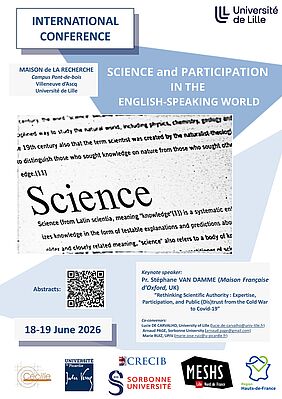
Colloque " Science and Participation in the English-Speaking World "
Pouvoirs, sociétés, cultures ColloqueLes 18 et 19 juin 2026: colloque " Science and Participation in the English-Speaking World ".
Il se déroulera à l'Université de Lille ( Maison de la recherche - Campus du Pont-de-Bois).
Le colloque est organisé par Lucie de Carvalho (Univ de Lille - CECILLE) en collaboration avec Arnaud Page (Sorbonne Université) et Marie Ruiz (UPJV), grâce au soutien de CECILLE, Sorbonne Université, l'UPJV, le CRECIB et la MESH Hauts de France.
Thursday 18 June
10:15–11:45 am | Panel 1 – From Local Societies to Imperial Science: Circulation, Authority, and Participation
Chair: Lucie de Carvalho (Université de Lille)
Annabel Storr (Durham University, UK)
“Asiatic Societies and Imperial British Scientific Networks in the Production and Dissemination of Amateur Scientific Research in East Asia”
Ali Hatapçı (University of Burgundy, France)
“‘An Army Looking for a Leader’?: Local Scientific Societies and the British Association for the Advancement of Science in the Late Nineteenth Century”
Robert Ivermee (Sciences Po Grenoble, France)
“Henry Piddington and the ‘Law of Storms’: The Amateur Foundations of Modern Meteorological Science in British India”
1:30–2:30 pm | Panel 2 – Mediating Participation: Art, Media, and the Co-Production of Environmental Knowledge
Chair: Ali Hatapçı (University of Burgundy Europe, France)
Yang Feng (University of Leeds, UK)
“Constructing and Disseminating Science with the Public through Art: Art-Based Public Engagements in Science in the UK”
Lena Kervran (Nantes University, France)
“Empirical Ecocriticism: What Can Ecology and Social Sciences Learn from Readers, and How?”
2:30–3:00 pm – Coffee break
3:00–4:30 pm | Panel 3 – Imperial Collectors: Authority and Engagement
Chair: Arnaud Page (Sorbonne University)
Aparajita Mukhopadhyay (University of Kent, UK)
“Rethinking Botanical Empire: Science and Silk in Colonial South Asia”
Mélanie Cournil (Sorbonne University, France)
“A One-Way Science? Participation and Scientific Authority in William Jackson Hooker’s Botany”
Maud Michaud (Université du Mans, France)
“‘The Seductiveness of Collection’: Missionary Collections in Britain’s Imperial Museums (1880s–1930s)”
Friday 19 June
9:00–10:30 am | Keynote Address
Stéphane Vandamme (Maison Française d’Oxford, UK)
“Rethinking Scientific Authority: Expertise, Participation, and Public (Dis)Trust from the Cold War to COVID-19”
Chair: Géraldine Vaughan (Université de Lille)
10:30–11:00 am – Coffee break
11:00 am–12:30 pm | Panel 4 – Managing Participation: Science and Institutional Authority
Chair: Philippe Vervaecke (Université de Lille)
Ville Aula (University of Oxford, UK)
“How to Overturn the Lack of Expertise in the Generalist Tradition of the UK Civil Service?”
Lucie Genay (Université Grenoble Alpes, France)
“Atoms in the Sagebrush: The Battle for Nuclear Education in Idaho”
Chiara Maria Pulvirenti (Sapienza University of Rome, Italy)
“‘The Periphery Principle’ and its Limits: Joseph Needham, UNESCO, and the Politics of Scientific Participation in the Postwar World”
2:00–4:00 pm | Workshop – At the Crossroads of Humanities and Hard Sciences: International Research Projects and Research Challenges
Chair: Marie Ruiz (Université de Picardie Jules Verne)
2:00–3:30 pm – Presentations on European cooperation in science and humanities, and on the interfaces between the humanities and the hard sciences: ethical and societal questions
Marie Gompel (Cellule Europe – Université de Lille)
Roel Van Overmeire (RTD SSH Integration Team, Unit “Health & Societal Transitions”, DG Research and Innovation, European Commission, Brussels)
Marialuisa Dal Poz (DG Agriculture and Rural Development Unit F2 – Research and Innovation, European Commission, Brussels)
Fatiha Fort (Horizon Europe National Contact Point – PCN Bio-environnement)
3:30–4:00 pm – Discussion, feedback on interdisciplinary research projects, and coffee break
4:00–4:30 pm – Conclusion and next steps Lucie de Carvalho, Arnaud Page, Marie Ruiz